
If the thought of lying inside an MRI scanner makes your chest tighten, you are far from alone. Feeling anxious or claustrophobic about MRI scans is one of the most common concerns patients raise with us at Unirad Diagnostic Imaging in Glasgow — and it is completely manageable with the right preparation.
Why MRI Scanners Feel Different From Other Scans
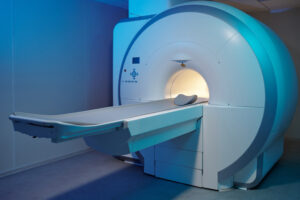
Unlike an X-ray or CT scan, an MRI scan uses a strong magnet and radio waves to build detailed images of soft tissue, which means you need to lie still inside a tunnel-shaped scanner for longer. The machine is also noisier — you will hear knocking and buzzing sounds as it works. For most people this is simply unfamiliar. For some, especially anyone with a history of claustrophobia or anxiety in enclosed spaces, it can feel overwhelming before they have even arrived for their appointment.
How Long Does an MRI Scan Actually Take?
Most single-area MRI scans (a knee, shoulder, or spine, for example) take between 20 and 40 minutes. A full body scan takes longer, closer to 60–90 minutes depending on the package. Knowing the real timeframe in advance often takes the edge off the anxiety — it is rarely as long as people imagine, and you are never in the tunnel continuously without breaks between sequences.
Practical Tips for a Calmer Scan
- Ask about a wide-bore scanner. Modern wide-bore machines have a noticeably larger opening than older models, which can make a big difference if enclosed spaces worry you.
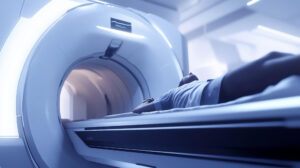
- Go in feet first when possible. For scans of the knee, shoulder, or lower spine, you may be positioned so your head stays outside or near the opening of the scanner for longer.
- Bring your own music or ask for headphones. Many clinics, including ours, offer music through headphones during the scan to help you relax and mask the machine noise.
- Use simple breathing techniques. Slow, steady breathing (in for four counts, out for six) can help calm your nervous system before and during the scan.
- Keep your eyes closed or use a face cloth. Not seeing the tunnel walls close to your face removes a lot of the visual trigger for anxiety.
- Tell the radiographer beforehand. Letting our team know you feel anxious means we can talk you through each step, explain the noises in advance, and check in with you throughout via the intercom.
- Bring someone with you. Having a friend or family member in the waiting room — and in some cases in the scanning room itself — can be reassuring.
- Ask your GP about it in advance if you are very anxious. If you know your anxiety is severe, it is worth discussing options such as a mild relaxant with your GP well before your appointment date, as this needs to be arranged and taken under medical guidance.
- Remember you are always in control. You will be given a call button or bulb to hold. If you need the scan paused at any point, you simply squeeze it and our radiographer will stop immediately.
What We Do Differently at Unirad
At our Glasgow clinic, every patient who mentions feeling nervous gets a walk-through of the scanner and the process before they lie down — not just a leaflet. Our radiographers talk to you through the intercom throughout the scan, and appointments are scheduled with enough time that nobody feels rushed. Most patients tell us the anticipation was the hardest part, and that the scan itself was far more manageable than they expected.
If you have specific concerns about claustrophobia, sedation, or what to expect, do raise it with your GP beforehand, and feel free to mention it when you book — our team is happy to talk you through the process over the phone first.
Book Your MRI Scan in Glasgow
Unirad Diagnostic Imaging offers private MRI scans with no GP referral required, fast appointments, and a calm, patient-first approach. Reports are typically ready within 5 working days.
Book online: unirad.co.uk/book
Call us: 0141 846 9116
Visit us: 22 Loanbank Quadrant, Glasgow G51 3HZ
This article is for general information only and is not a substitute for medical advice. Please consult your GP if you have concerns about your health or about undergoing an MRI scan.